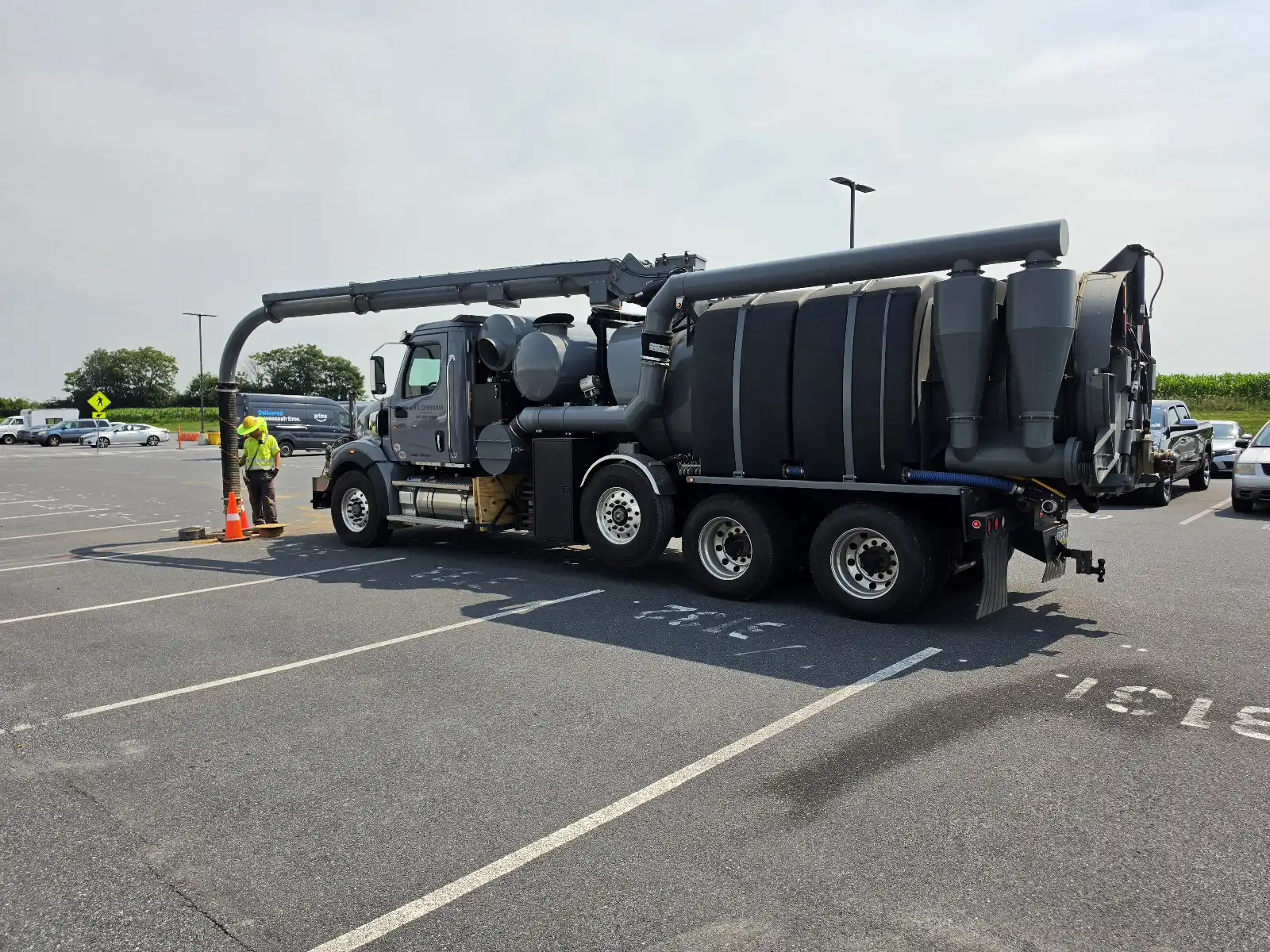
Utility potholing is the practice of digging a small, precise test hole to expose a buried utility. It lets you confirm a line’s exact position, depth, size, and material before you start excavating or drilling.
Paint marks on the ground are a good start, but they aren’t the whole story. A locate gives you an approximate horizontal position and not much else. No depth, no diameter, no indication of whether the record it came from predates the township rebuilding that road in 1987.
The cost of guessing wrong keeps climbing. On August 13, 2026, the Common Ground Alliance published Between the Lines: The True Cost of Damage to America’s Buried Utilities, which puts the annual economic cost of damage to buried utilities at $83.2 billion. That works out to roughly $227 million a day, and it’s nearly three times the $30 billion figure the industry had been quoting since 2019.
The ratio inside that number is the useful part. For every dollar spent on direct repairs, nearly $16 goes to everything that follows: shut-down businesses, stalled projects, closed roads, emergency response, and injuries.
Potholing is one of the simplest ways to stay out of that statistic.
Key Takeaways
- Utility potholing is a small test hole dug to expose a buried line and verify its exact horizontal position, depth, diameter, and material.
- It goes by several names. Daylighting, soft digging, soft excavation, test holes, and SUE test holes all describe the same basic idea.
- Most potholing today uses hydro excavation or air vacuum excavation. Pressurized water or air removes soil quickly without cutting into a pipe or conduit.
- An 811 locate and a test hole are not the same thing. The locate gives you an approximate horizontal position. Only a test hole gives you a verified depth.
- Pennsylvania law expects it. Act 287 requires prudent digging techniques inside the 18-inch tolerance zone and specifically names hand-dug test holes and vacuum excavation.
- In Pennsylvania, when the information provided isn’t sufficient to excavate safely, the statute puts the cost of that verification work on the project owner.
- It produces Quality Level A data. Under ASCE 38-22, physically exposing the line is the highest confidence level available.
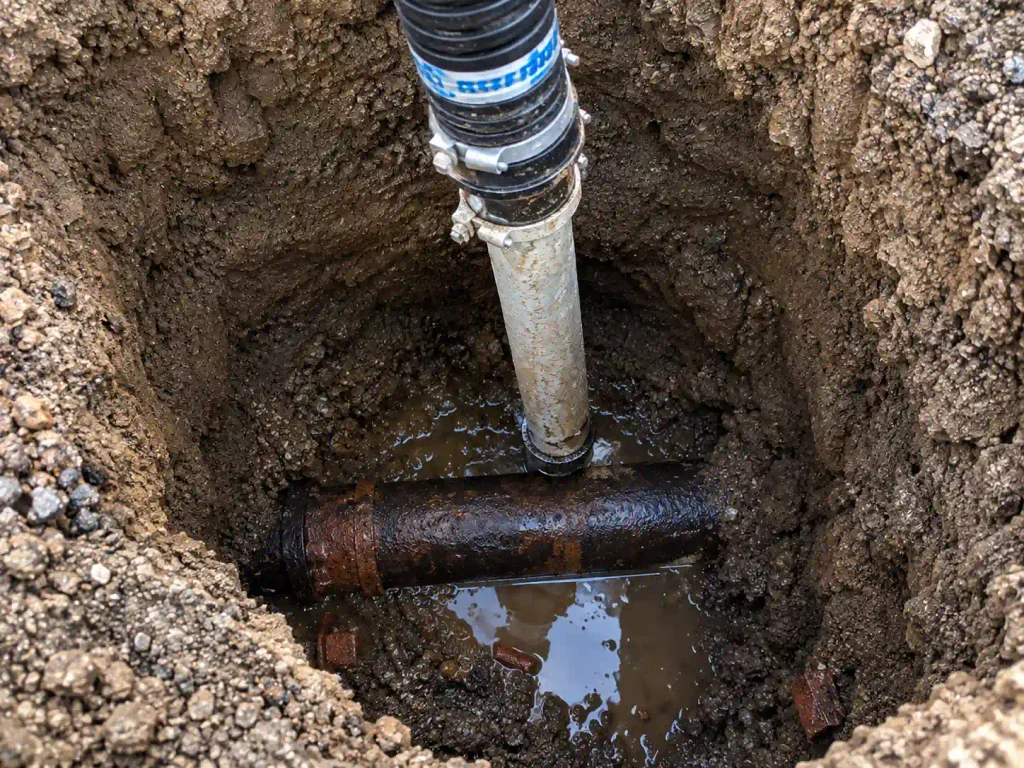
Operator using a hydro excavation wand to remove soil in controlled passes over a buried line
What Is Utility Potholing?
Utility potholing is the process of opening a small, controlled hole in the ground so you can physically see a buried utility line before the real digging or drilling starts.
The hole is usually modest, often just a foot or two across. The point is to actually see the pipe or conduit, measure it, record it, and close the hole back up.
Once a line is exposed, a crew records what actually matters:
- Depth from grade to the top of the line
- Horizontal position, measured off a fixed reference or surveyed outright
- Outside diameter
- Material: ductile iron, PVC, HDPE, steel, clay, direct-buried cable, duct bank
- Condition of the pipe, if visible
- Whether anything else is sharing the trench
That last item is worth its own note. Old joint trenches are common across Pennsylvania, and finding a second line just below the first is a much better outcome down a test hole than through a reamer on a bore. That’s why we always look for the bottom of the pipe, not just the top.
For example, on a past project along Route 422 in Hershey, a 4-inch plastic gas line was potholed. The drill plan assumed it was the only pipe. However, hidden just two feet below was a second, unrecorded 4-inch gas line. A strike there interrupted service to downtown Hershey businesses and impacted rail operations. Had the crew potholed down just two feet further to confirm the bottom of the trench, the second line would have been found. That industry lesson is why we always verify the bottom of the utility, not just the top.
Potholing, Daylighting, and Soft Digging: Are They the Same Thing?
Mostly, yes. The terms overlap and get used loosely in the field.
Daylighting means exposing a buried line so it can see the light of day. In practice, crews use it when exposing a longer stretch of pipe, while potholing usually means a discrete hole at one specific point.
Soft digging and soft excavation refer to the method: removing soil with water or air rather than steel teeth.
Test hole and SUE test hole are the engineering terms. SUE stands for Subsurface Utility Engineering, the discipline of investigating and documenting existing underground utilities to a defined confidence level. A SUE test hole usually comes with a formal datasheet and survey coordinates attached.
One quick note: in the U.K., “potholing” means cave exploring, what Americans call spelunking. If you’ve ever Googled the word and landed on photos of people in helmets squeezing through limestone, that’s why. In North American construction, it means utility test holes.
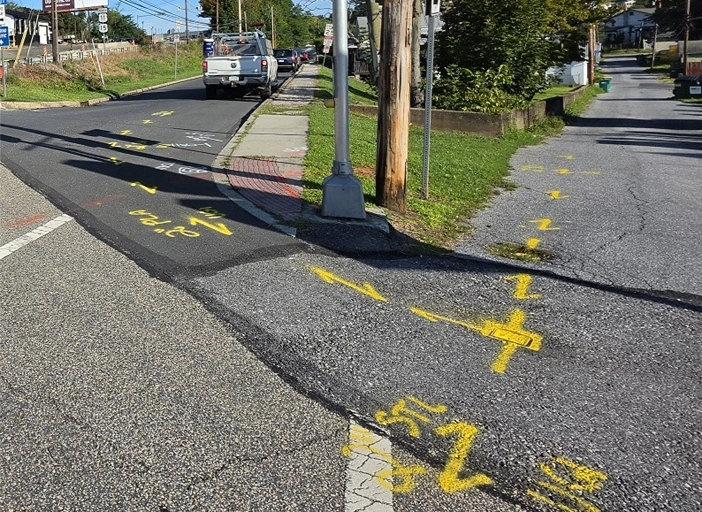
PA One Call utility locate marks and flags showing approximate horizontal position only
Potholing vs. an 811 Locate: What the Marks Don’t Tell You
A PA One Call locate gives you an approximate horizontal position. It is not designed to give you depth. That gap is where most trouble lives.
Locators work from utility records, and those records vary widely in quality. Some are excellent. Some are a faded hand sketch from a filing cabinet. Grade changes, resurfacing, and past road work all change the relationship between the surface and what’s under it.
Private lines are the other gap. Farm electric, irrigation, propane, or a sewer lateral run by a previous owner may not be marked at all, because nobody owns the responsibility to mark them.
| Feature | 811 / PA One Call Locate | Potholing |
|---|---|---|
| What it gives you | Approximate horizontal position | Verified position, depth, diameter, material |
| Depth information | No | Yes |
| Private lines | Not covered | Covered when included in scope |
| Cost to excavator | Free | Priced per hole |
| Who performs it | Facility owner’s locator | Excavator or SUE contractor |
| ASCE 38-22 confidence | Quality Level B | Quality Level A |
Both belong on a project. The locate tells you where to look. The test hole tells you what’s there.
When Pennsylvania Law Requires Potholing
Pennsylvania’s Underground Utility Line Protection Law, Act 287 of 1974, as amended by Act 127 of 2024, sets the rules for excavators in the state. Three provisions matter here.
The notification window. Excavators must notify PA One Call — 811 — no fewer than three business days and no more than 10 business days before excavation begins.
The 18-inch tolerance zone. The tolerance zone is the horizontal space within 18 inches of the outside wall or edge of a line. Inside that zone, the excavator must employ prudent techniques to determine the precise position of the facility. The statute specifically names hand-dug test holes and vacuum excavation as examples.
How the law treats soft excavation. Act 287 excludes soft excavation technology — vacuum, high pressure air, and high pressure water — from its definition of “excavation work.” That’s a statutory carve-out, not an endorsement, and it’s worth reading carefully. It means the legislature recognizes these methods as categorically different from powered mechanical excavation. It does not mean a vac truck lets you skip a One Call ticket on your project. If you’re excavating, notify.
So while the statute never uses the word “potholing,” it describes the practice, names the tools, and expects the verification. If you’re working within 18 inches of a marked utility in PA and you aren’t verifying by hand or vacuum, you’re on the wrong side of the requirement.
Who Pays for It Under PA Law
This provision gets overlooked, and it’s worth knowing before you price a job.
Act 287 requires the excavator to use prudent techniques inside the tolerance zone. Where the information provided isn’t sufficient to excavate safely, the excavator must employ those same techniques, and the statute puts that cost on the project owner, with compensation handled on a force-account basis under the PennDOT Form 408 specifications for extra work.
The law goes a step further. Any contract provision, public or private, that attempts to limit an excavator’s rights under this section is invalid, and any attempted waiver is void and unenforceable as against public policy.
In plain terms: in Pennsylvania, when a project owner hands you inadequate utility information, the cost of finding out what’s actually down there is the project owner’s cost. That’s statutory, not custom, and a contract can’t sign it away.
Potholing and ASCE 38-22: What “Quality Level A” Means
If you work with engineers, municipalities, or PennDOT, you’ve seen utility drawings labeled QL-A through QL-D. That comes from ASCE 38-22, the standard for investigating and documenting existing utilities. The quality levels describe how much you can trust the ink on the plan.
| Quality Level | How the data is obtained | Confidence |
|---|---|---|
| QL-D | Existing records and recollection only | Lowest |
| QL-C | QL-D data correlated with surveyed surface features (manholes, valves) | Low |
| QL-B | Surface geophysics — designating the line with paint and flags | Moderate |
| QL-A | Exposing the line in a test hole and surveying it | Highest |
QL-A is the only level that requires physically exposing the utility. Every level below it is an inference drawn from records, surface features, or geophysical response.
You don’t need QL-A everywhere. Potholing an entire corridor is expensive and rarely justified. The value comes from putting test holes where the uncertainty carries the most risk: crossings, tie-ins, and the tight spots where a two-foot error changes the design.
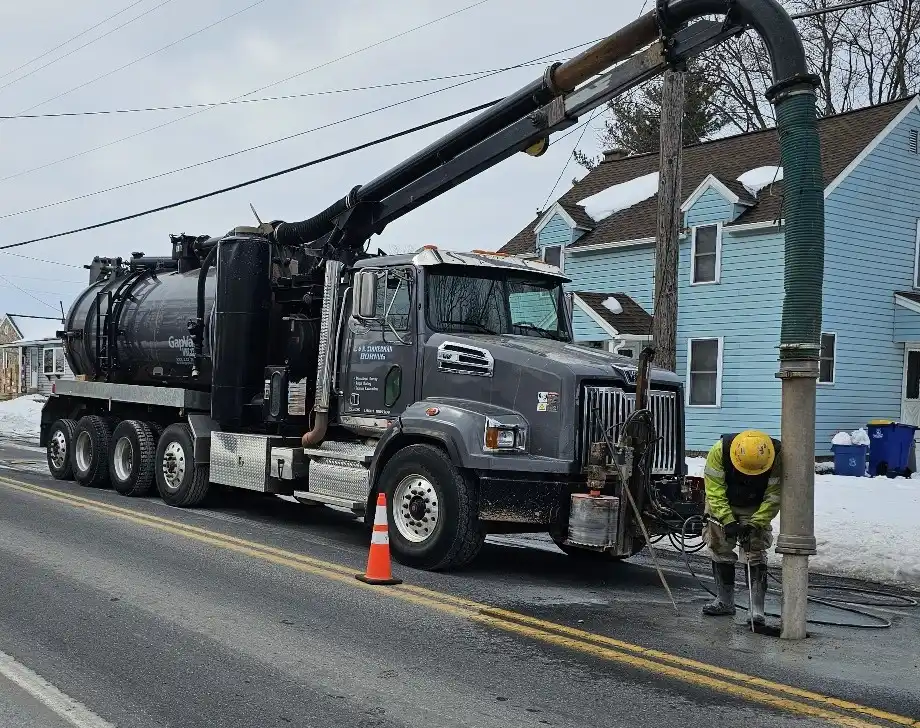
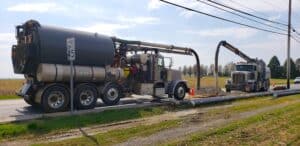
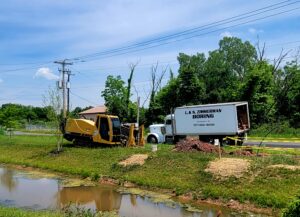
L&N Zimmerman vacuum truck on site for a directional boring project in central Pennsylvania
How Potholing Actually Works, Step by Step
Every site throws a different curveball, but the sequence generally looks like this.
- One Call ticket and locate. The ticket goes in, the wait period runs, and facility owners mark their lines. Nothing else starts until this happens.
- Records review. We look at what the plans show, what the marks show, and where those two disagree. A disagreement is a good reason to add a test hole.
- Identify likely private utilities. This takes field judgment. A Lancaster County farm with three outbuildings almost certainly has electric running between them, and nobody is coming out to mark it.
- Choose the method. Water, air, or hand dig.
- Cut the surface. Pavement gets cored or saw-cut. Sod gets carefully lifted and set aside for restoration.
- Excavate in controlled passes. The operator works down in stages rather than gunning for target depth. As the line comes into view, the pace slows.
- Measure and record. Depth to top of line, offset from a fixed reference, diameter, material, condition. Photos are taken. On SUE work, a surveyor ties the hole to the project datum.
- Backfill and restore. The hole is compacted, the surface is replaced, and the site is left clean.
Step 7 is the whole reason for the hole, and it’s the step rushed crews shortchange most. A test hole nobody wrote down is just a hole. A test hole with a depth, an offset, and a photo is data that keeps a drill head out of trouble two weeks later.
Hydro Excavation vs. Air Vacuum vs. Hand Digging
| Method | Speed | Best For | Drawbacks |
|---|---|---|---|
| Hydro excavation (water) | Fast | Hard and compacted soil, clay, rocky ground | Spoil returns as wet slurry; difficult in freezing weather |
| Air vacuum | Moderate | Sites where spoil must be reused dry; colder weather | Struggles in hard or compacted ground; higher equipment cost |
| Hand digging | Slow | Very shallow, highly congested, or tight-access work | Very slow; high labor cost |
At L&N Zimmerman, we use hydro excavation exclusively. We run hydro because our vacuum trucks are already on site for our directional boring operations, where they are simultaneously used to clean up drill slurry. Pressurized water is also simply the better tool for the ground we drill in. While air vacuum has an advantage when spoil needs to go back in the hole dry, water cuts through the challenging soils of Pennsylvania much faster.
Most clays, soft shales, and soil with small rocks are excellent candidates for hydro excavation. However, when we hit solid limestone, sandstone, hard shale, or large boulders, all common in Lebanon, Lancaster, and Berks counties, potholing becomes unfeasible.
Fortunately, most existing utilities were trenched in via open cut and backfilled with stone, clean soil, or soil with small rocks, meaning they can still be easily potholed even in rocky regions. The exception is when you need to pothole a utility that was originally installed via directional boring through solid rock; in those cases, the surrounding rock can make exposing the line nearly impossible.
How Deep Can You Pothole?
Soil conditions and specific equipment specs play a huge part in achievable depth. Vacuum blowers vary by truck; larger blowers generate better suction, with lift measured in inches of mercury (in. Hg) and airflow in CFM determining the maximum depth. Generally speaking, 20 to 25 feet is the absolute maximum depth we can achieve. However, that depth makes standard potholing very difficult. For our projects, a standard, efficient potholing depth ranges between 2 feet and 12 feet.
What About Winter Work?
Potholing is possible in the winter, but the cold slows down production and increases costs. Because we rely on hydro excavation, the actual air temperature affects us more than the depth of the ground frost. Sub-freezing air can freeze the water used in the process and cause the excavated debris to freeze inside the vacuum tubes.
Generally, when temperatures drop into the low teens or lower, potholing becomes impossible without a specialized hot water system, which we do not use. If you have winter utility work scheduled, the weather forecast will dictate our schedule just as much as the ground conditions.
When Is Potholing Worth It?
Potholing isn’t free, and it doesn’t belong on every hole. Here’s where it makes sense.
- Before a directional bore. Horizontal directional drilling puts a product line under everything in its path. Every known crossing along that path is a candidate for a test hole.
- At tie-ins and connections. You need the exact elevation, not a range.
- Where records conflict. Two drawings that disagree are reason enough to dig one small hole.
- On sites with private utilities. Farms, older commercial properties, and anywhere with buildings added over time.
- Under state highway, township road, or railroad rights-of-way. These crossings carry strict permit conditions, and the owners expect verification.
- Near high-pressure gas, transmission-grade fiber, or primary electric. The consequences of a strike scale rapidly with what’s inside the line.
If you’re weighing boring against open trenching on a congested site, potholing usually strengthens the case for boring. Knowing exactly where the obstacles sit is what lets you thread a bore between them.
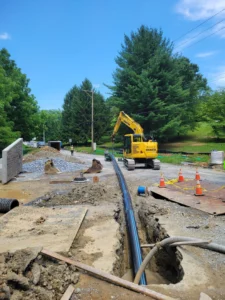
For example, earlier this year, we completed a project in Richland Borough, PA, where we needed to install an 8-inch sewer force main. Before drilling, we potholed the existing water services to verify their exact depth and location. The test holes revealed a wide variety of depths across the services, allowing us to adjust the elevation of the new sewer line accordingly and navigate the bore safely.
What Does Potholing Add to a Boring Project?
We pothole on projects we’re already drilling or excavating. It isn’t something we sell on its own, and that works in your favor on price: the vacuum truck is already on site cleaning drill slurry, so there’s no separate mobilization to absorb.
We bill by the hour, but for budgeting purposes, a standard test hole on a project we’re already drilling generally starts around $150 (subject to depth, surface restoration, and site conditions).
What moves that number:
- Number of holes. Several crossings verified in one pass cost far less per hole than a single hole worked in isolation.
- Depth. Deeper holes take longer and generate more spoil.
- Surface type. Grass backfills easily. Concrete, asphalt, and finished hardscape mean coring, patching, and sometimes a separate restoration crew.
- Spoil handling. If slurry has to leave the site, you’re paying for trucking and disposal.
- Water access. A nearby hydrant keeps the hydro truck working. No source means trips off-site to refill.
Here’s the arithmetic that usually settles it. Potholing is priced in the hundreds. A utility strike is priced in the tens of thousands before you count downtime.
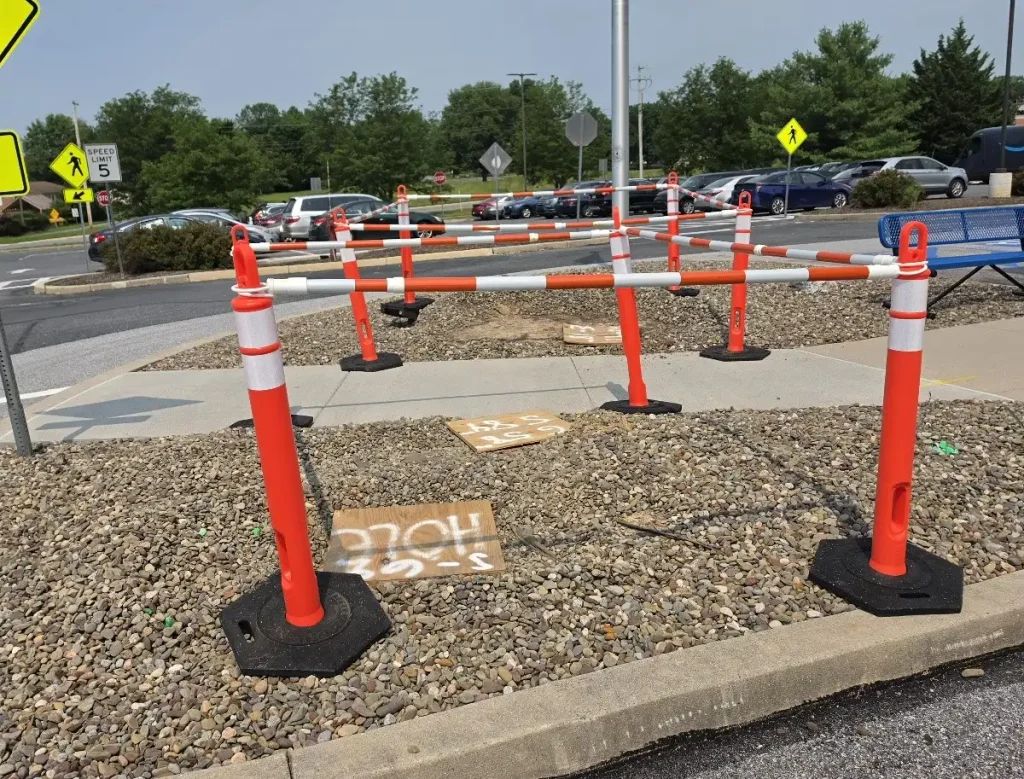
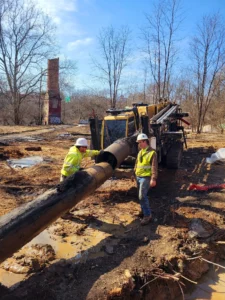
L&N Zimmerman hydro excavation potholing project in central Pennsylvania
Frequently Asked Questions
What does potholing utilities mean?
It means digging a small test hole to expose a buried utility line so its exact position, material, and depth can be seen, measured, and recorded before excavation or drilling begins.
What is another name for potholing?
Daylighting, soft digging, soft excavation, test holing, and SUE test holes all describe the same practice. In engineering documents, you’ll most often see it called a test hole.
Is potholing required by law in Pennsylvania?
PA Act 287 requires prudent techniques inside the 18-inch tolerance zone around a marked line, and specifically names hand-dug test holes and vacuum excavation as acceptable methods. In practice, verification is legally expected.
Does potholing damage the utility?
When done correctly with the right equipment, no. That’s the entire point of using water or air instead of a backhoe bucket. Pressure, nozzle distance, and operator technique all matter, particularly around coated steel and direct-buried cable.
Who pays for potholing on a project?
In Pennsylvania, Act 287 puts the cost on the project owner where the information provided wasn’t sufficient to excavate safely, and contract language attempting to waive that isn’t enforceable. Outside that situation, allocation follows the contract, so settle it before work starts.
Does L&N Zimmerman offer standalone potholing?
No. We pothole as part of the directional boring and excavation projects we’re performing. If you need test holes without associated drilling work, a dedicated SUE or vacuum excavation contractor is the right call.
Potholing Ahead of Your Boring Project in Central and Southeastern PA
Potholing is part of how we drill, not a service we sell separately. Before a boring project begins, we verify that all utility conflicts and crossings are investigated by potholing. A crew goes out ahead of the drill, opens the crossings, records what’s there, and adjusts the drilling plan before anyone spools out a single foot of pipe. It’s unglamorous work that quietly prevents an expensive day.
If your boring project has unknowns underneath it, contact L&N Zimmerman. We’ll walk the site, look at what the plans show against what’s marked, and tell you where a test hole is worth digging and where it isn’t.